How to Price Car Repair Jobs UK: A Workshop Guide
3 October 2026 · 8 min read
Written by Daniel Staples — Director, MechanicX. Workshop operator and developer of MechanicX garage management software.

A busy workshop can still lose money on work that looks profitable. A repair quote may cover the parts and hands-on labour but miss diagnosis, preparation or final testing. If you’re working out how to price car repair jobs uk, those overlooked hours can quietly eat into your margin.
Customers need a clear price, and your workshop needs to cover its costs. The answer is a repeatable method, not guesswork. This guide shows you how to cost labour, parts and overheads, account for VAT and build in a sensible margin. You’ll also learn how to explain estimates clearly and compare quoted work with the time and costs recorded on the completed job. Keeping estimates, job cards and invoices together makes that review easier and reduces unnecessary admin.
How to price car repair jobs in the UK: build your cost base first
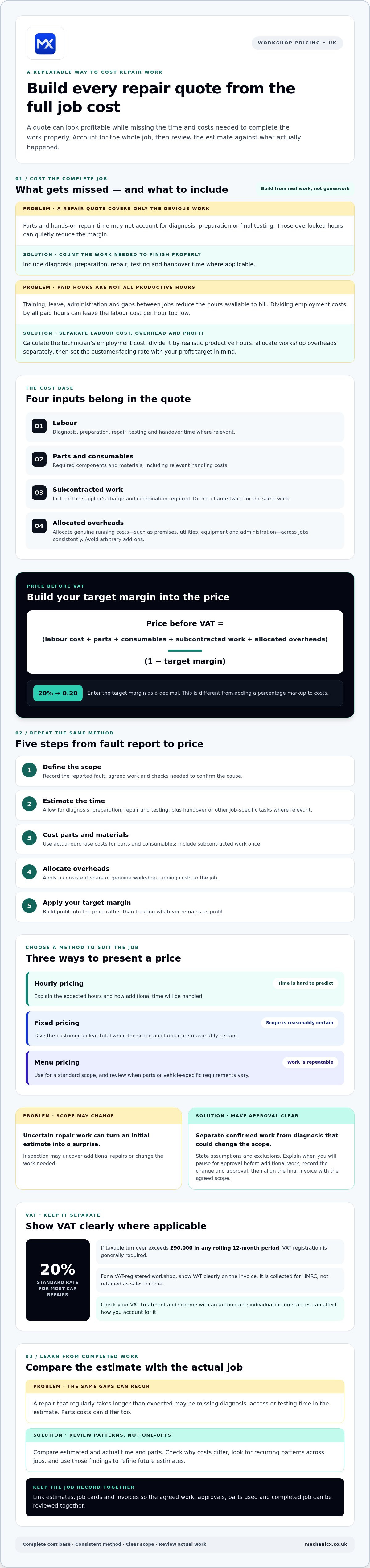
A sustainable quote starts with the full cost of doing the work, not just the time spent with a spanner in hand. To work out how to price car repair jobs uk, build each price from labour, parts, consumables and a fair share of workshop overheads, then include your target profit. Add VAT where applicable.
Keep the technician’s employment cost separate from your labour rate and workshop overheads. Wages and related employment costs cover paid time, but not every paid hour can be billed. Training, leave, administration and gaps between jobs reduce productive hours, so dividing employment costs by all paid hours can leave your rate too low. Calculate the cost of employing the technician, then divide it by realistic productive hours to establish a labour cost per hour. Allocate workshop overheads separately, and set your customer-facing rate with your profit target in mind.
What costs belong in a car repair quote?
Include the work needed to complete the job properly, not only the repair itself:
- Labour: diagnosis, preparation, repair, testing and handover time where applicable.
- Parts and consumables: list the required components and materials, including any relevant handling costs.
- Subcontracted work: include the supplier’s charge and any coordination required, but don’t charge twice for the same work.
- Overheads: allocate genuine running costs, such as premises, utilities, equipment and administration, across jobs using a consistent basis. Avoid arbitrary add-ons.
VAT is separate from workshop revenue. The standard rate for most car repairs is 20%. If your taxable turnover exceeds £90,000 in any rolling 12-month period, VAT registration is generally required. If your workshop is VAT registered, show VAT clearly on the invoice. It’s collected for HMRC, not retained as sales income. Check your VAT treatment and scheme with an accountant, as individual circumstances can affect how you account for it.
How to calculate a car repair price: a repeatable workshop method
A consistent process makes it easier to price different jobs fairly and spot where estimates need refining. Use these steps for each repair:
- Define the scope. Record the reported fault, agreed work and any checks needed to confirm the cause.
- Estimate the time. Include diagnosis, preparation, repair and testing. Allow for handover or other job-specific tasks where relevant.
- Cost parts and materials. Use your actual purchase costs for parts and consumables, and include subcontracted work once.
- Allocate overheads. Apply a consistent share of genuine workshop running costs to the job.
- Apply your target margin. Build profit into the price rather than treating whatever remains as profit.
Formula: Price before VAT = (labour cost + parts + consumables + subcontracted work + allocated overheads) ÷ (1 − target margin). Enter the margin as a decimal, so a 20% target is 0.20. This is different from adding a percentage markup to costs.
Choose the pricing method to suit the job. Hourly pricing works when the time required is hard to predict, provided the estimate explains the expected hours and how additional time will be handled. Fixed pricing gives customers a clear total when the scope and labour are reasonably certain. Menu pricing suits repeatable work with a standard scope, but review it when parts or vehicle-specific requirements vary.
How should estimates handle uncertain repair work?
Separate confirmed work from diagnosis that could change the scope. State assumptions and exclusions, and explain when you’ll pause for approval before carrying out additional work. Clear wording helps prevent surprises. A garage job card template guide can help keep findings and approvals tied to the repair record.
Keeping estimates and job records together in garage management software also helps you compare quoted and actual work, then refine future estimates. That’s a practical part of learning how to price car repair jobs uk without relying on guesswork.
Protecting repair job margins and explaining prices
A quote doesn’t have to be the cheapest to feel fair. Show what the price covers: the agreed repair, parts, labour and checks needed to confirm the work is complete. A clear breakdown helps customers understand the value and gives them a useful basis for approving the job. Competing on the lowest figure can leave essential work, or your margin, out of the calculation.
After completion, compare the estimate with the actual time and parts used. If a repair regularly takes longer than expected, check whether diagnosis, access or testing time is missing from the estimate. If parts costs differ, find out why before updating your pricing. Look for recurring patterns across jobs, rather than reacting to a one-off difference, and use them to refine future estimates.
How can garages make repair estimates clearer and easier to review?
Keep the estimate aligned with the work completed. If inspection reveals additional repairs, record the change and customer approval before adding it to the job. Explain the reason for the change, then make sure the final invoice reflects the agreed scope and any approved additions.
Digital job records can connect the estimate, work carried out, parts used and invoice details. This makes it easier to trace a job from approval through to payment and creates a consistent record for reviewing estimated and actual work. For practical context on organising workshop processes, read this 2026 garage management guide.
MechanicX brings estimates, digital job cards and invoices together in one cloud platform, with job information accessible on phones, tablets and desktop devices. If you’re refining how to price car repair jobs uk, organised records help you review each quote and make informed adjustments. Explore how MechanicX garage management software can support your workshop’s workflow.
Build a more consistent approach to every repair quote
Reliable pricing starts with a complete cost base, a repeatable method and clear communication about what the estimate covers. Then compare estimated time and parts with the completed job. Reviewing those differences helps you spot recurring gaps and refine future quotes, rather than letting small underestimates chip away at your margin.
If you’re refining how to price car repair jobs uk, organised records make the process easier to follow. MechanicX keeps digital job cards and estimates accessible across phones, tablets and desktop devices, helping you keep job information together. Integrations with Xero, QuickBooks and Zoho Books can also connect workshop records with your accounting workflow.
See how MechanicX keeps job cards, estimates and invoices organised. Make each quote clearer, learn from completed work and build a pricing process that works for your workshop.
Frequently Asked Questions
How do I calculate a labour rate for car repairs?
Divide the cost of employing your technicians by a realistic number of productive, billable hours, then account for your target profit. Don’t treat every paid hour as billable: leave, training, administration and gaps between jobs reduce productive time. This gives you a cost-based labour rate. Review it against actual workshop performance so it stays grounded in your figures, and allocate other workshop overheads separately.
What should a car repair estimate include?
A useful estimate sets out the agreed work, expected labour time, parts and consumables, any subcontracted work, applicable VAT and the total payable. Include diagnosis, preparation and testing where relevant, and state any assumptions or exclusions. If further findings could change the scope, explain when you’ll pause and seek approval. Clear detail helps customers understand what the price covers before work begins.
Should a UK garage show VAT separately on a repair quote?
Yes. If your garage is VAT registered, show the VAT amount and the total including VAT clearly so the customer can see the full price. The standard VAT rate for most car repairs is 20%. If you’re not VAT registered, don’t add VAT to the quote. Check your VAT treatment with an accountant, particularly if you use a VAT accounting scheme.
Can a garage change a repair estimate after work has started?
An estimate may need revising if diagnosis reveals additional work or the scope changes. Explain the reason and revised cost to the customer before proceeding with the extra work, and record their approval. A fixed quote is different: don’t treat it as an open-ended estimate. Clear written terms and records help prevent disputes about what was agreed and the final invoice.
Frequently Asked Questions
What costs belong in a car repair quote?
Include the work needed to complete the job properly, not only the repair itself: VAT is separate from workshop revenue. The standard rate for most car repairs is 20%. If your taxable turnover exceeds £90,000 in any rolling 12-month period, VAT registration is generally required. If your workshop is VAT registered, show VAT clearly on the invoice. It’s collected for HMRC, not retained as sales income. Check your VAT treatment and scheme with an accountant, as individual circumstances can affect how you account for it. A consistent process makes it easier to price different jobs fairly and spot where estimates need refining. Use these steps for each repair: Formula: Price before VAT = (labour cost + parts + consumables + subcontracted work + allocated overheads) ÷ (1 − target margin). Enter the margin as a decimal, so a 20% target is 0.20. This is different from adding a percentage markup to costs. Choose the pricing method to suit the job. Hourly pricing works when the time required is hard to predict, provided the estimate explains the expected hours and how additional time will be handled. Fixed pricing gives customers a clear total when the scope and labour are reasonably certain. Menu pricing suits repeatable work with a standard scope, but review it when parts or vehicle-specific requirements vary.
How should estimates handle uncertain repair work?
Separate confirmed work from diagnosis that could change the scope. State assumptions and exclusions, and explain when you’ll pause for approval before carrying out additional work. Clear wording helps prevent surprises. A garage job card template guide can help keep findings and approvals tied to the repair record. Keeping estimates and job records together in garage management software also helps you compare quoted and actual work, then refine future estimates. That’s a practical part of learning how to price car repair jobs uk without relying on guesswork. A quote doesn’t have to be the cheapest to feel fair. Show what the price covers: the agreed repair, parts, labour and checks needed to confirm the work is complete. A clear breakdown helps customers understand the value and gives them a useful basis for approving the job. Competing on the lowest figure can leave essential work, or your margin, out of the calculation. After completion, compare the estimate with the actual time and parts used. If a repair regularly takes longer than expected, check whether diagnosis, access or testing time is missing from the estimate. If parts costs differ, find out why before updating your pricing. Look for recurring patterns across jobs, rather than reacting to a one-off difference, and use them to refine future estimates.
How can garages make repair estimates clearer and easier to review?
Keep the estimate aligned with the work completed. If inspection reveals additional repairs, record the change and customer approval before adding it to the job. Explain the reason for the change, then make sure the final invoice reflects the agreed scope and any approved additions. Digital job records can connect the estimate, work carried out, parts used and invoice details. This makes it easier to trace a job from approval through to payment and creates a consistent record for reviewing estimated and actual work. For practical context on organising workshop processes, read this 2026 garage management guide. MechanicX brings estimates, digital job cards and invoices together in one cloud platform, with job information accessible on phones, tablets and desktop devices. If you’re refining how to price car repair jobs uk, organised records help you review each quote and make informed adjustments. Explore how MechanicX garage management software can support your workshop’s workflow. Reliable pricing starts with a complete cost base, a repeatable method and clear communication about what the estimate covers. Then compare estimated time and parts with the completed job. Reviewing those differences helps you spot recurring gaps and refine future quotes, rather than letting small underestimates chip away at your margin. If you’re refining how to price car repair jobs uk, organised records make the process easier to follow. MechanicX keeps digital job cards and estimates accessible across phones, tablets and desktop devices, helping you keep job information together. Integrations with Xero, QuickBooks and Zoho Books can also connect workshop records with your accounting workflow. See how MechanicX keeps job cards, estimates and invoices organised. Make each quote clearer, learn from completed work and build a pricing process that works for your workshop.
How do I calculate a labour rate for car repairs?
Divide the cost of employing your technicians by a realistic number of productive, billable hours, then account for your target profit. Don’t treat every paid hour as billable: leave, training, administration and gaps between jobs reduce productive time. This gives you a cost-based labour rate. Review it against actual workshop performance so it stays grounded in your figures, and allocate other workshop overheads separately.
What should a car repair estimate include?
A useful estimate sets out the agreed work, expected labour time, parts and consumables, any subcontracted work, applicable VAT and the total payable. Include diagnosis, preparation and testing where relevant, and state any assumptions or exclusions. If further findings could change the scope, explain when you’ll pause and seek approval. Clear detail helps customers understand what the price covers before work begins.
Should a UK garage show VAT separately on a repair quote?
Yes. If your garage is VAT registered, show the VAT amount and the total including VAT clearly so the customer can see the full price. The standard VAT rate for most car repairs is 20%. If you’re not VAT registered, don’t add VAT to the quote. Check your VAT treatment with an accountant, particularly if you use a VAT accounting scheme.
Can a garage change a repair estimate after work has started?
An estimate may need revising if diagnosis reveals additional work or the scope changes. Explain the reason and revised cost to the customer before proceeding with the extra work, and record their approval. A fixed quote is different: don’t treat it as an open-ended estimate. Clear written terms and records help prevent disputes about what was agreed and the final invoice.
More articles



Try MechanicX free for 30 days
No card required. Set up in an afternoon and book tomorrow's jobs into it — that's the real test.