Mastering Workshop Capacity Planning for UK Garages
17 September 2026 · 7 min read
Written by Daniel Staples — Director, MechanicX. Workshop operator and developer of MechanicX garage management software.

A fully booked diary is often the biggest lie in the motor trade. You look at a packed schedule and see success, but without proper workshop capacity planning, the reality is usually a stressful mix of overstretched technicians and unrecovered labour hours. It's a common trap. You're working flat out, yet the profit at the end of the month doesn't reflect the hard work happening on the shop floor.
Breaking this cycle is about balancing your available technician hours with real-time customer demand so you never have to choose between a let-down customer and a burnt-out team. You'll learn how to eliminate overbooking and maximise workshop profit by tracking labour more effectively. This guide explains how to use digital job sheets and smart scheduling to remove idle time and turn that chaotic calendar into a predictable, high-margin engine for your garage.
The Fundamentals of Workshop Capacity Planning
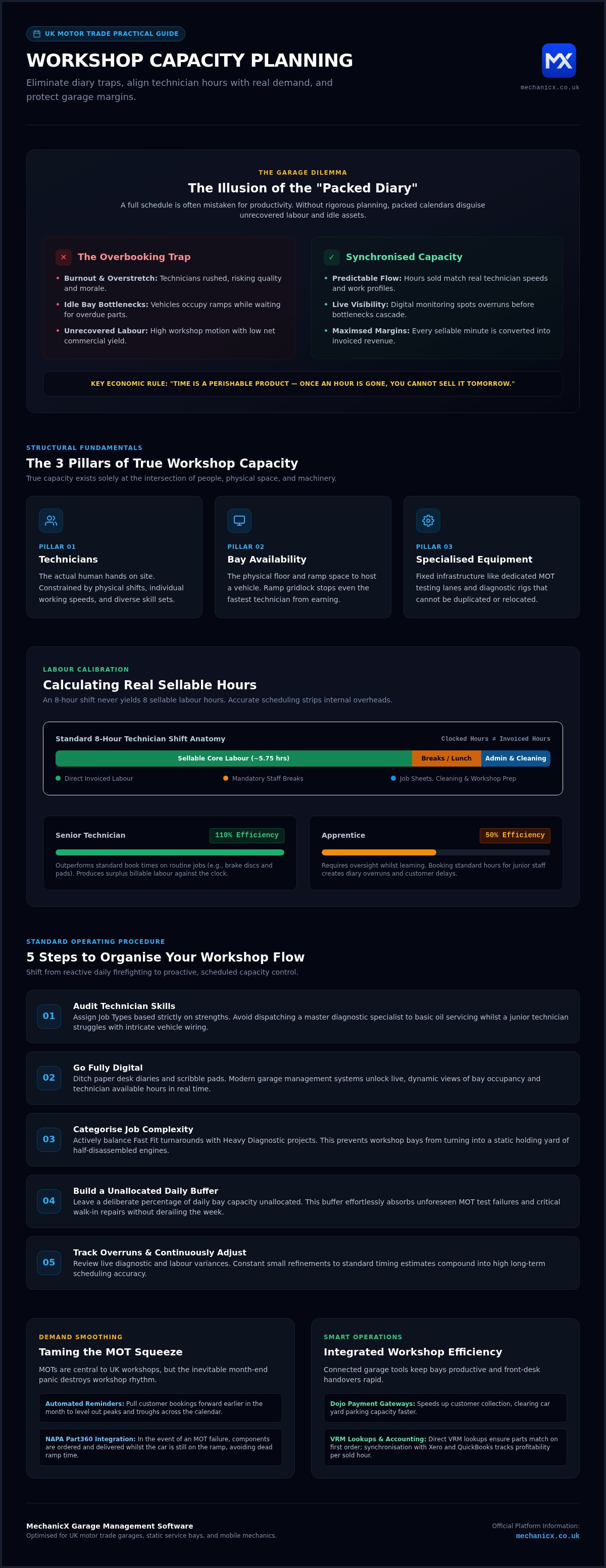
In a busy UK garage, workshop capacity planning is the art of knowing exactly how many labour hours you can realistically sell before the shutters go down. It isn't just about how many cars you can squeeze onto the forecourt. True capacity is the intersection of your people, your space, and your tools. These constraints often overlap, but forgetting even one can cause a bottleneck that brings the whole shop to a standstill.
Think of it as three pillars supporting your profit:
- Technicians: The actual hands available to do the work.
- Bay Availability: The physical space to put a vehicle.
- Specialised Equipment: Fixed assets like MOT lanes that cannot be moved.
Many managers mistake a full diary for a productive workshop. If your diary is packed but your bays sit idle because parts haven't arrived, you aren't planning; you're just reacting. This mismatch leaks thousands in profit because time is a perishable product. Every minute a bay sits empty because of a scheduling error is money straight out of your pocket. Once an hour is gone, you can't sell it tomorrow.
Calculating Your True Available Hours
To find your real capacity, start with the clock. If a technician works an eight-hour shift, you don't have eight hours to sell. You must strip away time for breaks, cleaning, and admin. Technician efficiency is the ratio of clocked hours to invoiced hours. A senior tech might hit 110% efficiency on routine brakes, whilst an apprentice might only manage 50% as they learn. Adjusting your diary to reflect these different speeds ensures you don't overpromise and underdeliver.
5 Steps to Organise Your Workshop Flow
Effective workshop capacity planning requires a shift from reactive firefighting to active management. Here is how to tidy up your workflow and protect your margins.
- Step 1: Audit technician skills. Assign "Job Types" based on strengths. Don't waste a diagnostic expert on basic servicing whilst a junior drowns in complex wiring.
- Step 2: Go digital. Ditch the paper diary. You cannot see real-time capacity on a scribbled desk pad. Moving to a garage management system gives you a live view of every bay and every hour.
- Step 3: Categorise complexity. Balance "Fast Fit" work with "Heavy Diagnostic" projects. This prevents your workshop from becoming a graveyard of half-finished engines.
- Step 4: Build a buffer. Leave a small percentage of your day unallocated. This absorbs inevitable MOT failures and walk-ins without wrecking your week.
- Step 5: Track and adjust. Use your data to spot where jobs are overrunning. Constant small tweaks to your timing will lead to much better long-term accuracy.
Managing the Squeeze: MOTs and Unplanned Repairs
MOTs are the heartbeat of UK garages, but they shouldn't cause a panic. Use automated MOT reminders to pull bookings forward and spread the load across the month. This avoids the end-of-month rush that often leads to overbooking. When a car fails, NAPA Part360 integration ensures parts arrive whilst the vehicle is still on the ramp. It keeps your bays clear and your technicians productive. If you're ready to reclaim your time, it might be time to upgrade your workshop diary for better control.
Leveraging Digital Tools for Maximum Efficiency
Digital tools are the final piece of the puzzle. They turn your plan into a living schedule. For instance, digital job cards allow you to see job progress in real time. You don't need to leave the office or shout across the workshop floor to know if a job is overrunning. This visibility is essential for active workshop capacity planning because it lets you move jobs around before a bottleneck forms.
Efficiency also extends to the front desk. Integrating payments with Dojo speeds up vehicle collection. When customers pay faster, cars leave your yard sooner. This frees up vital parking capacity and keeps the flow moving. Similarly, using vehicle registration lookups ensures you order the right parts the first time. It eliminates the re-work and "dead time" that often kills a productive afternoon.
Modern workshops are also becoming more flexible. Cloud-based systems make it easy to manage mobile mechanic diaries right alongside your static bays. You get a single, unified view of your entire team's availability, regardless of where they are working. It removes the guesswork and ensures every sellable hour is accounted for.
The Future of Workshop Automation
Predictability is the ultimate goal for any garage owner. Automating your service reminders creates a baseline of work for the months ahead. This allows you to spot quiet periods before they happen and fill them. By synchronising your data with Xero or QuickBooks, you can track the actual profitability of your planned hours. It's about seeing the pound signs, not just the clock. Ready to see how MechanicX can tidy your diary and boost your margins? Book a demo today and take back control of your shop floor.
Take Control of Your Shop Floor
Effective workshop capacity planning isn't about working harder; it's about working smarter with the hours you already have. By auditing your team's skills, categorising job complexity, and leaving room for the unexpected, you move from daily firefighting to a calm, organised environment. You've seen how digital tools like real-time job sheets and automated reminders remove the administrative weight that holds most garages back. Reclaiming those lost hours is the fastest way to boost your bottom line without hiring more staff.
MechanicX is built for UK mechanics who want results without the complex jargon. With seamless NAPA and Dojo integrations, it's designed to keep your bays full and your profit margins healthy. It's time to stop guessing and start growing. Start your free trial of MechanicX and master your workshop diary today. You have the skills to fix the cars; now give yourself the tools to run the business you deserve.
Frequently Asked Questions
How do I calculate my workshop capacity manually?
To calculate your capacity, multiply the number of technicians by their daily shift hours and subtract non-productive time. If you have four technicians working eight hours, you start with 32 hours. Once you remove time for breaks, cleaning, and admin, you might only have 28 sellable hours. Accurate workshop capacity planning relies on knowing this true figure before you start booking in jobs.
What is the ideal technician efficiency rate for a UK independent garage?
Most UK independent garages aim for a technician efficiency rate between 85% and 100%. This figure represents the ratio of hours clocked on a job versus the hours actually invoiced to the customer. Whilst 100% is the ideal, factors like apprentice training or complex diagnostic work can lower this. Consistently tracking this data helps you understand your workshop's real-world output.
Can I manage workshop capacity using a paper diary?
You can use a paper diary, but it's a risky strategy for a modern workshop. Paper doesn't update in real time or alert you when you've over-allocated a specific technician's hours. It makes workshop capacity planning a manual chore rather than a streamlined process. Switching to digital systems prevents the double-booking errors that lead to stressed staff and unhappy customers.
How does parts availability affect my workshop capacity planning?
Parts availability is the silent killer of workshop efficiency. If a vehicle is taking up a ramp whilst waiting for a filter or brake pads, your capacity for that bay drops to zero. Using registration lookups and integrations like NAPA Part360 ensures the right parts arrive at the right time. This keeps the workflow moving and prevents your planned labour hours from being lost.
Frequently Asked Questions
How do I calculate my workshop capacity manually?
To calculate your capacity, multiply the number of technicians by their daily shift hours and subtract non-productive time. If you have four technicians working eight hours, you start with 32 hours. Once you remove time for breaks, cleaning, and admin, you might only have 28 sellable hours. Accurate workshop capacity planning relies on knowing this true figure before you start booking in jobs.
What is the ideal technician efficiency rate for a UK independent garage?
Most UK independent garages aim for a technician efficiency rate between 85% and 100%. This figure represents the ratio of hours clocked on a job versus the hours actually invoiced to the customer. Whilst 100% is the ideal, factors like apprentice training or complex diagnostic work can lower this. Consistently tracking this data helps you understand your workshop's real-world output.
Can I manage workshop capacity using a paper diary?
You can use a paper diary, but it's a risky strategy for a modern workshop. Paper doesn't update in real time or alert you when you've over-allocated a specific technician's hours. It makes workshop capacity planning a manual chore rather than a streamlined process. Switching to digital systems prevents the double-booking errors that lead to stressed staff and unhappy customers.
How does parts availability affect my workshop capacity planning?
Parts availability is the silent killer of workshop efficiency. If a vehicle is taking up a ramp whilst waiting for a filter or brake pads, your capacity for that bay drops to zero. Using registration lookups and integrations like NAPA Part360 ensures the right parts arrive at the right time. This keeps the workflow moving and prevents your planned labour hours from being lost.
More articles



Try MechanicX free for 30 days
No card required. Set up in an afternoon and book tomorrow's jobs into it — that's the real test.