Small Garage Cash Flow: A Practical Guide for 2026
19 September 2026 · 7 min read
Written by Daniel Staples — Director, MechanicX. Workshop operator and developer of MechanicX garage management software.

Why does your bank account look so empty when your ramps have been full all week? It’s a common frustration for many workshop owners. You’re putting in the hours and doing the hard graft, yet the money seems to disappear before you can even pay yourself. Managing cash flow in a small garage business is often the hardest part of the job; it is particularly draining when you’re paying for expensive parts upfront whilst waiting weeks for trade accounts to settle their bills.
It doesn't have to be this way. This guide will show you how to stabilise your workshop’s finances, eliminate cash leaks, and ensure your bank balance actually reflects how hard you work. We’ll explore practical ways to speed up payment collection, capture every minute of wasted labour, and gain total visibility over your profit margins on every single job.
Managing Cash Flow: Why Garages Often Feel 'Busy but Broke'
Managing cash flow in a small garage business is about timing. It is the gap between paying your technicians and parts suppliers today, and receiving money from the customer later. You might have a full workshop, but if that cash is tied up in unpaid invoices or parts sitting on the shelf, you are effectively "busy but broke." This syndrome happens when high turnover masks a lack of actual liquid cash in the bank.
Seasonal shifts often make this problem worse. MOT peaks create a false sense of security, followed by quiet "dead zones" where the bills keep coming but the phone stays silent. To survive these dips, you must capture every billable second. Tracking labour hours accurately is the only way to ensure your time does not vanish into thin air. If it isn't on the invoice, you're working for free.
Identifying the 'Cash Leaks' in Your Daily Workshop Operations
Profit often drains away in small, unnoticed drops. Think about the brake cleaner, copper grease, or trim clips your team uses every day. If these aren't added to the invoice, you are subsidising the customer's repair. Paper-based systems make this worse; grease-stained job sheets are hard to read and easily lost, meaning jobs get under-billed or forgotten entirely. Digital systems stop these leaks by making recording instant and legible.
Your labour recovery rate is the percentage of clock hours your mechanics work that actually ends up billed to a customer.
A Step-by-Step Framework for Improving Your Workshop’s Cash Position
Stop acting like an interest-free lender. The fastest way to fix your bank balance is a strict 'Payment on Collection' policy for all retail work. Chasing invoices is a waste of your time and energy. When managing cash flow in a small garage business, you need the money in your account before the keys go back to the customer.
Review your commercial trade accounts with the same scrutiny. If a local firm takes 60 days to pay, they are using your cash to fund their business. Shorten these terms or move them to digital payments. Using a tool like MechanicX helps you automate your invoicing and see exactly who owes what in real-time.
Organise your tax obligations by setting aside a 'VAT and Tax' buffer weekly. Transfer a fixed percentage of your takings into a separate pot every Friday. This simple habit turns a potential quarterly crisis into a routine admin task. Don't forget your parts markup either. It must cover the hidden labour of sourcing, ordering, and handling returns, not just the base cost of the metal.
Mastering Parts Procurement and Trade Account Management
Modern parts management is about speed. Use NAPA Part360 Integration to access live pricing and availability from your desktop. This ensures your quotes are always profitable. It is a vital part of managing cash flow in a small garage business. Consolidate your spend with fewer factors to negotiate better payment terms. Avoid stocking 'just-in-case' items. Dusty boxes are just frozen cash. Stick to 'just-in-time' ordering to keep your money liquid.
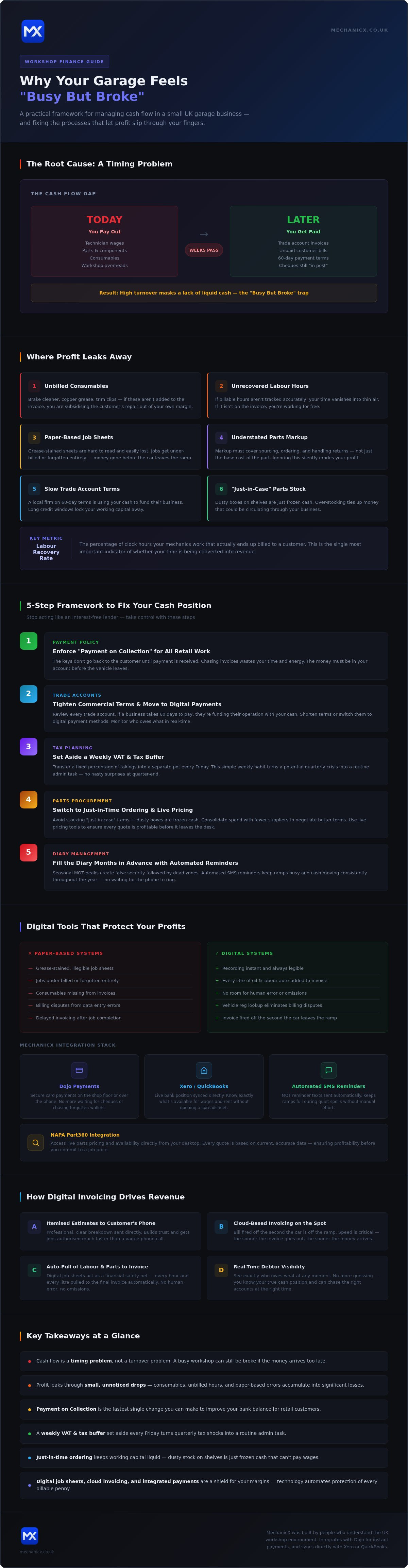
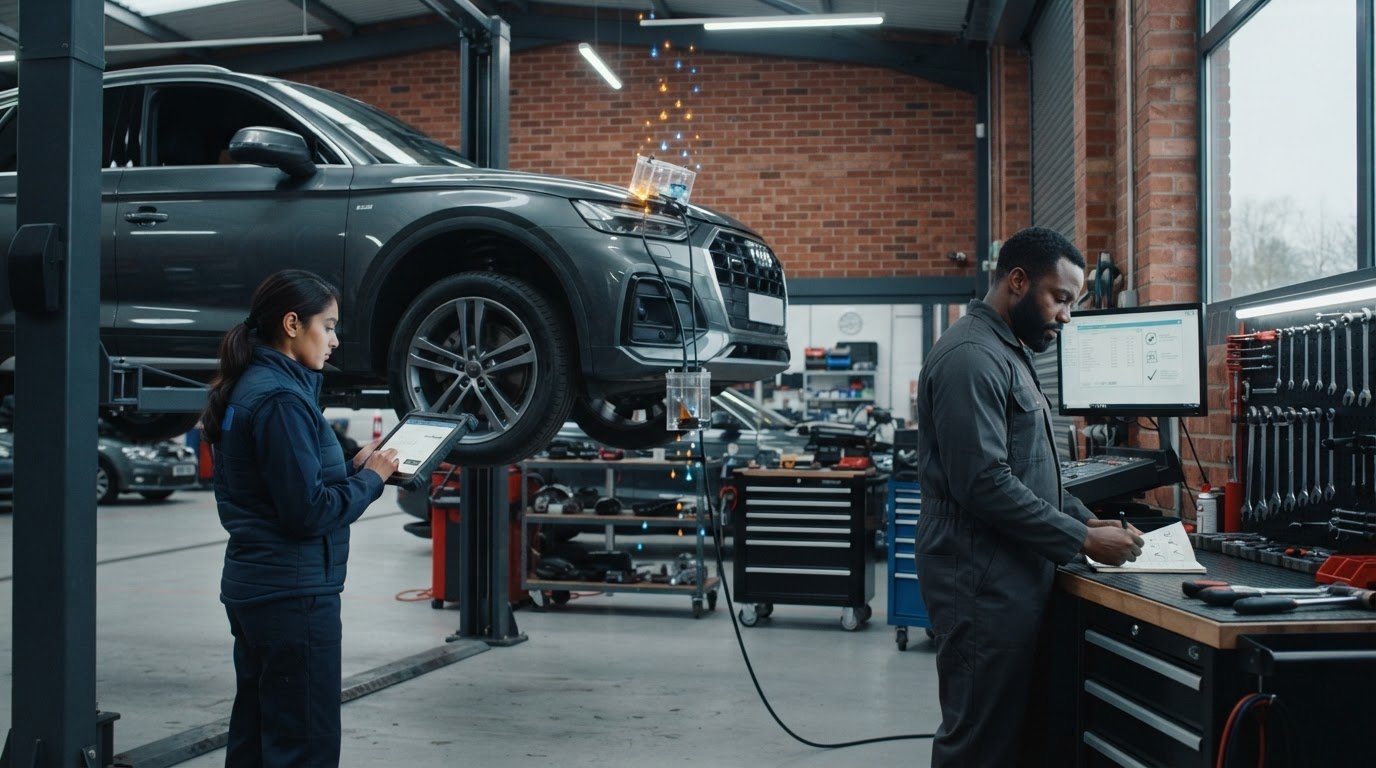
Leveraging Digital Tools to Protect Your Profits Automatically
Technology isn't a burden; it's a shield for your margins. Filling your diary months in advance is the best way to handle managing cash flow in a small garage business. Using automated MOT reminders via SMS ensures you aren't sitting around waiting for the phone to ring during quiet spells. It keeps the ramps busy and the cash moving consistently throughout the year.
Speed is vital for managing cash flow in a small garage business. Cloud-based invoicing allows you to fire off a bill the second the car is off the ramp. When you pair this with Dojo payment integration, you can take secure card payments right on the shop floor or over the phone. No more waiting for "cheques in the post" or chasing customers who "forgot" their wallet. Syncing this workshop data with accounting software like Xero or QuickBooks gives you a live look at your bank position. You'll know exactly what's available for wages and rent without opening a single spreadsheet.
Transforming Invoicing from a Chore into a Revenue Driver
Digital job sheets act as your financial safety net. They ensure every litre of oil and every hour of labour is pulled onto the final invoice automatically, leaving no room for human error. Customers appreciate the clarity of a professional, itemised digital estimate sent straight to their phone. It builds trust, looks professional, and gets the job authorised much faster than a vague phone call. Vehicle registration lookups eliminate the simple data entry errors that often lead to billing disputes and delayed payments.
Take Control of Your Workshop's Financial Future
Managing cash flow in a small garage business is about more than just fixing cars; it's about fixing the processes that let profit slip through your fingers. By ditching grease-stained paper for digital job sheets and setting firm payment terms, you can finally align your bank balance with the effort you put in every day. Automation and real-time visibility are your best tools for ending the 'busy but broke' cycle for good.
MechanicX was built by people who understand the UK workshop environment. It integrates with Dojo for instant payments and syncs directly with Xero or QuickBooks to keep your accounts in order. Stop the cash leaks and take control of your workshop with MechanicX. You've done the hard work on the tools; now it's time to make sure you get paid for it. Your more profitable future starts today.
Frequently Asked Questions
What is the biggest cause of cash flow problems in UK garages?
The primary culprit is the timing gap between paying for parts and receiving customer payments. Many workshops suffer when they front the cost of expensive components but wait weeks for an invoice to be settled. Managing cash flow in a small garage business becomes impossible if you don't account for invisible costs like consumables or wasted labour hours that never make it onto the job sheet.
Should I offer credit terms to trade customers or local businesses?
Only offer credit if the volume of work justifies the risk. Trade accounts can quickly become a burden if they treat your garage as an interest-free bank. If you do provide terms, keep them short, such as 14 or 30 days, and use automated systems to track overdue balances. Always prioritise retail customers who pay on collection to keep your cash liquid.
How can I stop customers from leaving their cars for days without paying?
Implement a payment on collection policy and communicate it clearly when the booking is made. Sending a professional digital estimate via SMS before work begins helps manage expectations. For larger repairs, ask for a deposit to cover parts. Using integrated payment tools like Dojo allows you to take card details over the phone or send secure payment links the moment the job is finished.
Is it worth using a trade account for parts or should I pay upfront?
Trade accounts are excellent for managing cash flow in a small garage business because they allow you to align your supplier payments with your customer income. However, you must avoid the temptation to over-order. Use integrations like NAPA Part360 to see live pricing and ensure your markups are protected. Consolidating your spend with one or two reliable factors often leads to better settlement terms.
Frequently Asked Questions
What is the biggest cause of cash flow problems in UK garages?
The primary culprit is the timing gap between paying for parts and receiving customer payments. Many workshops suffer when they front the cost of expensive components but wait weeks for an invoice to be settled. Managing cash flow in a small garage business becomes impossible if you don't account for invisible costs like consumables or wasted labour hours that never make it onto the job sheet.
Should I offer credit terms to trade customers or local businesses?
Only offer credit if the volume of work justifies the risk. Trade accounts can quickly become a burden if they treat your garage as an interest-free bank. If you do provide terms, keep them short, such as 14 or 30 days, and use automated systems to track overdue balances. Always prioritise retail customers who pay on collection to keep your cash liquid.
How can I stop customers from leaving their cars for days without paying?
Implement a payment on collection policy and communicate it clearly when the booking is made. Sending a professional digital estimate via SMS before work begins helps manage expectations. For larger repairs, ask for a deposit to cover parts. Using integrated payment tools like Dojo allows you to take card details over the phone or send secure payment links the moment the job is finished.
Is it worth using a trade account for parts or should I pay upfront?
Trade accounts are excellent for managing cash flow in a small garage business because they allow you to align your supplier payments with your customer income. However, you must avoid the temptation to over-order. Use integrations like NAPA Part360 to see live pricing and ensure your markups are protected. Consolidating your spend with one or two reliable factors often leads to better settlement terms.
More articles


Try MechanicX free for 30 days
No card required. Set up in an afternoon and book tomorrow's jobs into it — that's the real test.