UK VAT for Car Repairs: 2026 Guide for Workshops
21 September 2026 · 8 min read
Written by Daniel Staples — Director, MechanicX. Workshop operator and developer of MechanicX garage management software.

VAT compliance for your garage isn't actually an accounting problem; it's a data entry problem. You've likely spent Friday nights staring at oily job sheets, wondering if you've correctly applied the uk vat rules for car repairs to that insurance job or a subcontracted MOT. It's frustrating to feel like a part-time tax man when you'd rather be under a bonnet. We understand the stress of worrying that one small manual error might trigger a letter from HMRC or a 7.75% interest charge on late payments.
This 2026 guide will help you master the complexities of VAT and show you how to automate compliance. You'll get a clear breakdown of current rates, from the £90,000 registration threshold to the nuances of insurance claims. We'll also explore how digital tools generate VAT-compliant invoices in seconds, ensuring your workshop stays Making Tax Digital (MTD) compliant without the manual graft.
Understanding VAT on Car Repairs: Parts, Labour, and Rates
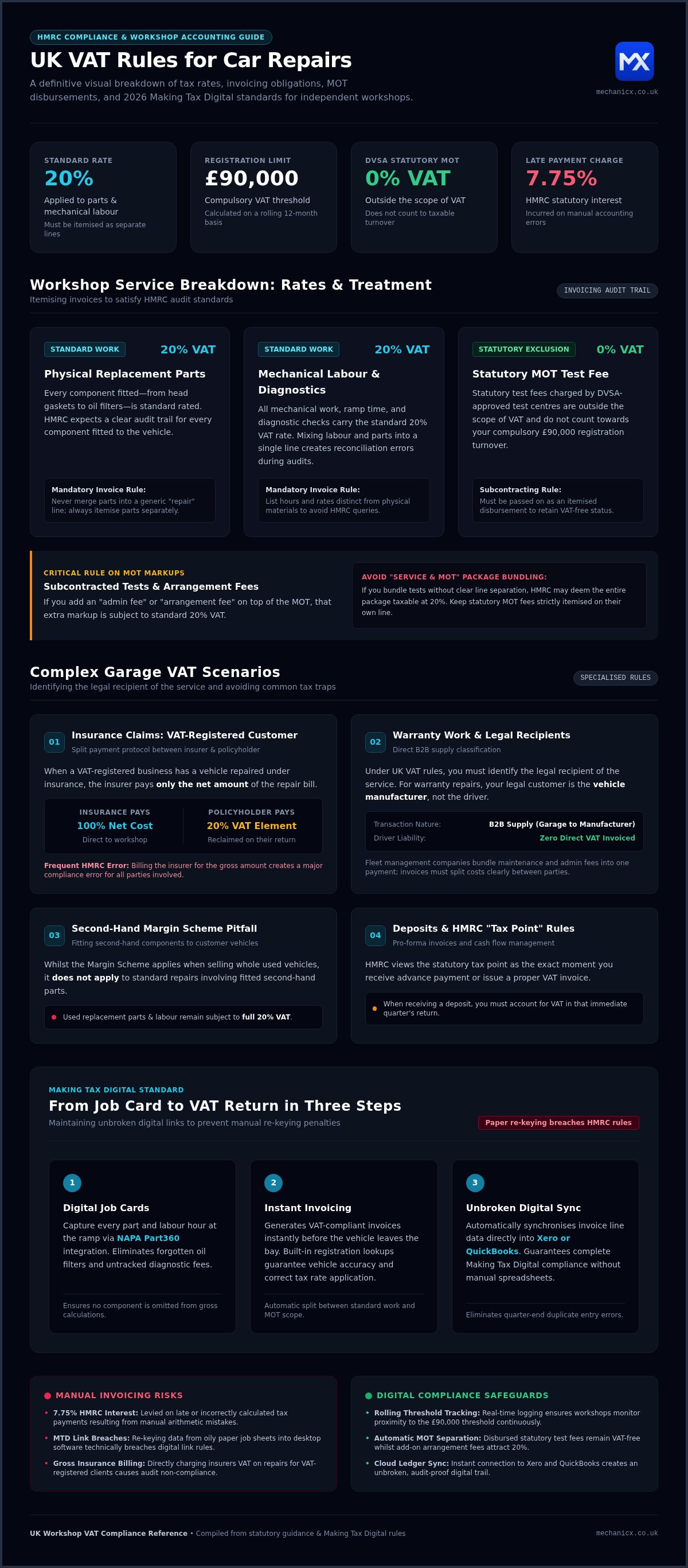
Most workshop services fall under the standard 20% rate. Whether you're replacing a head gasket or performing a diagnostic check, both the physical parts and your mechanical labour are taxable. It's vital to list these separately on your invoices. Mixing them into a single "repair" line makes it harder to reconcile your accounts and can lead to errors during an audit. Understanding the uk vat rules for car repairs means knowing that HMRC expects a clear audit trail for every component fitted.
For 2026, the compulsory VAT registration threshold remains at £90,000. This is calculated on a rolling 12-month basis, not just your financial year. If your turnover hits this mark, you must register. Using Digital Job Sheets ensures every bolt and every hour is logged; this way, you aren't guessing your proximity to the limit. It's about keeping control of your data before it becomes a headache.
The VAT Status of MOT Tests and Surcharges
The statutory MOT fee is outside the scope of VAT when charged by an authorised test centre. However, the rules change if you add a markup. If you charge an "admin fee" or "arrangement fee" on top of the test, that extra amount is subject to the standard 20% VAT rate.
The statutory MOT fee charged by a DVSA-approved centre is outside the scope of VAT and does not count towards your taxable turnover.
If you subcontract the test and pass the cost on as a disbursement, it stays VAT-free. Just ensure it's itemised separately. If you bundle it into a "Service and MOT" package without clear separation, HMRC might expect 20% on the whole lot. Modern systems like MechanicX help you split these lines automatically, protecting your margins and your compliance.
Handling Complex VAT Scenarios in the Garage
Standard retail work is straightforward, but insurance and warranty jobs add layers of admin. Under the uk vat rules for car repairs, you must identify exactly who the legal recipient of the service is. For warranty work, your customer is the vehicle manufacturer, not the driver. This is a B2B supply. Similarly, don't get caught out by the Second-Hand Margin Scheme. While it's great for selling used cars, it doesn't apply to standard repairs where you're fitting used parts; those remain subject to the full 20% VAT on both parts and labour.
Managing cash flow often requires deposits. Be careful with pro-forma invoices. HMRC views the "tax point" as the moment you receive payment or issue a proper VAT invoice. If you take a deposit, you must account for the VAT in that period. Using Digital Job Sheets helps you track these payments without losing the trail in a paper diary.
Insurance Claims and VAT-Registered Customers
When a VAT-registered business has a vehicle repaired under insurance, a specific rule applies. The insurer will only pay the "net" amount of the repair. The policyholder must pay the 20% VAT element directly to you, which they then reclaim on their own return. Getting this wrong is one of the most frequent errors regarding uk vat rules for car repairs. If you bill the insurer the full gross amount, you're creating a compliance error for everyone involved.
Fleet management companies often present a similar challenge. They may bundle maintenance and admin fees into one payment. You need an invoicing system that can split these costs clearly between multiple parties. Failure to separate these correctly is a common pitfall during HMRC audits, especially when dealing with high-volume fleet contracts.
Streamlining VAT Compliance with Digital Workshop Tools
Making Tax Digital (MTD) is no longer a "future" requirement; it's the 2026 standard for every registered garage. If you're still re-keying data from paper diaries into an accounting app, you're technically in breach of the digital link rules. It's a risk you don't need to take. HMRC's 7.75% interest rate on late payments makes manual errors expensive. Moving to a cloud-based system isn't just about pleasing the tax man. It's about recovering lost time and protecting your profit.
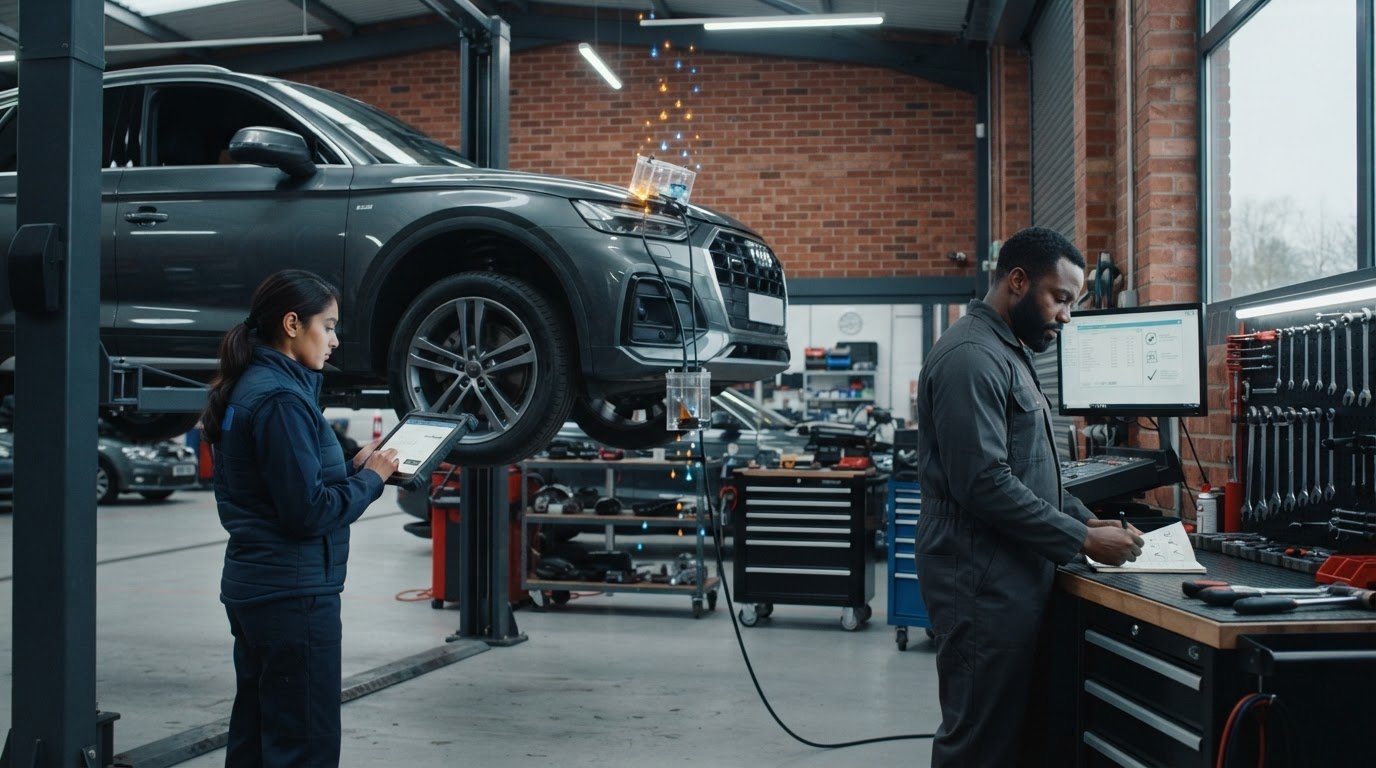
When every part and every labour hour is captured on a tablet at the ramp, your final invoice is ready before the car leaves the bay. This eliminates the "forgotten" oil filters or diagnostic fees that eat into your margins. Real-time integration with Xero or QuickBooks ensures your books stay accurate throughout the month. You avoid the end-of-quarter stress and the risk of overpaid tax caused by duplicate entries.
From Job Card to VAT Return in Three Steps
- Step 1: Use digital job cards to log parts via NAPA Part360 integration, ensuring you never miss a component.
- Step 2: Generate a VAT-compliant invoice instantly. Built-in registration lookups ensure vehicle accuracy and correct application of the uk vat rules for car repairs.
- Step 3: Automatically sync the data to your accounting software. This creates an unbroken digital link for a seamless, audit-proof VAT return.
Using these tools means your VAT return is practically done as you work. You get accuracy, speed, and total control over your workshop’s finances. It's about getting back to the work that actually pays the bills. Following the uk vat rules for car repairs shouldn't be a full-time job; it should be a background process.
Put Your Workshop Admin on Autopilot
Mastering the uk vat rules for car repairs doesn't have to mean spending your weekends buried in receipts. You've seen how accurate labour tracking and clear invoicing protect your margins on everything from routine MOTs to complex insurance claims. The transition to MTD in 2026 is an opportunity to ditch the manual errors that lead to HMRC headaches. By integrating your digital job sheets with Xero or QuickBooks, you're not just staying compliant; you're building a faster, more profitable business.
MechanicX is trusted by independent workshops across the UK to automate these headaches away. Our automated invoicing saves hours of admin every week. It lets you focus on the workshop floor instead of the office desk. Stop the VAT paperwork and try MechanicX for free today. You've got the skills to fix the cars; let us handle the spreadsheets.
Frequently Asked Questions
Do I have to charge VAT on labour if I am a mobile mechanic?
You only charge VAT on labour if you're VAT-registered. Registration is mandatory once your rolling 12-month turnover hits £90,000. If you're below this limit and haven't registered voluntarily, you don't add VAT to your invoices. Once registered, the standard 20% rate applies to all mechanical labour and any parts you supply. It's vital to monitor your turnover monthly to avoid missing the registration deadline.
Is an MOT test VAT-exempt for my customers?
The statutory MOT fee is outside the scope of VAT when performed by an authorised test centre. You don't charge VAT on the fee itself, up to the legal cap of £54.85 for a standard car. If you charge an additional admin fee for arranging the test, that specific markup is subject to 20% VAT. Always itemise these costs separately to keep your invoices clear and compliant.
How does Making Tax Digital (MTD) affect my small garage in 2026?
MTD means you must keep digital records and file returns using compatible software. In 2026, HMRC requires unbroken digital links between your daily records and your VAT return. Manual data entry or copy-pasting is no longer allowed. Using integrated tools like MechanicX ensures the uk vat rules for car repairs are applied correctly at the point of repair, making your quarterly filings a background task.
Can I reclaim VAT on the tools and equipment I buy for my workshop?
You can reclaim the VAT paid on business-related purchases like workshop tablets, tools, and diagnostic equipment if you're VAT-registered. This also applies to parts sourced through integrations like NAPA Part360. Always ensure you have a valid VAT invoice from your supplier to support your claim. If you're on the Flat Rate Scheme, remember that different rules apply for capital assets costing over £2,000.
Frequently Asked Questions
Do I have to charge VAT on labour if I am a mobile mechanic?
You only charge VAT on labour if you're VAT-registered. Registration is mandatory once your rolling 12-month turnover hits £90,000. If you're below this limit and haven't registered voluntarily, you don't add VAT to your invoices. Once registered, the standard 20% rate applies to all mechanical labour and any parts you supply. It's vital to monitor your turnover monthly to avoid missing the registration deadline.
Is an MOT test VAT-exempt for my customers?
The statutory MOT fee is outside the scope of VAT when performed by an authorised test centre. You don't charge VAT on the fee itself, up to the legal cap of £54.85 for a standard car. If you charge an additional admin fee for arranging the test, that specific markup is subject to 20% VAT. Always itemise these costs separately to keep your invoices clear and compliant.
How does Making Tax Digital (MTD) affect my small garage in 2026?
MTD means you must keep digital records and file returns using compatible software. In 2026, HMRC requires unbroken digital links between your daily records and your VAT return. Manual data entry or copy-pasting is no longer allowed. Using integrated tools like MechanicX ensures the uk vat rules for car repairs are applied correctly at the point of repair, making your quarterly filings a background task.
Can I reclaim VAT on the tools and equipment I buy for my workshop?
You can reclaim the VAT paid on business-related purchases like workshop tablets, tools, and diagnostic equipment if you're VAT-registered. This also applies to parts sourced through integrations like NAPA Part360. Always ensure you have a valid VAT invoice from your supplier to support your claim. If you're on the Flat Rate Scheme, remember that different rules apply for capital assets costing over £2,000.
More articles

Try MechanicX free for 30 days
No card required. Set up in an afternoon and book tomorrow's jobs into it — that's the real test.